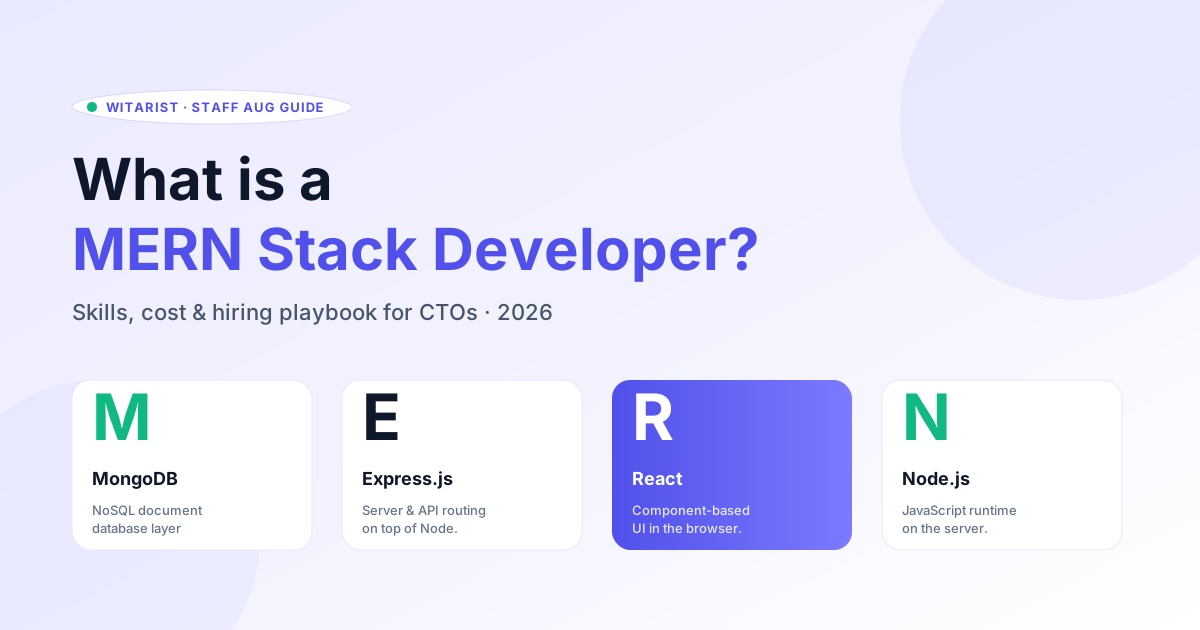
TL;DR for hiring managers: A MERN stack developer is a JavaScript engineer who builds the entire web app — UI, API, and database — using MongoDB, Express, React, and Node.js. In India, a senior MERN dev costs $50–$85/hour through staff augmentation, with a typical match in 24–48 hours. The stack is ideal for realtime apps, MVPs, and any product where you want one engineer to ship a feature end-to-end.
A MERN stack developer builds full-stack JavaScript web applications. MERN is an acronym for the four technologies they use: MongoDB (database), Express.js (server framework), React (frontend library), and Node.js (server runtime). One engineer, one language, the whole product.
Why hiring managers care: a MERN developer reduces the number of specialised hires you need. Instead of staffing a separate frontend, backend, and database team for a 5-person startup, one MERN engineer can ship a feature from the React component to the MongoDB index without handing off.
The 4 letters explained: M, E, R, N
M — MongoDB (the database layer)
MongoDB is a NoSQL document database. Unlike SQL databases that store rows in rigid tables, MongoDB stores flexible JSON-like documents. That maps cleanly to what JavaScript objects look like — which means no ORM impedance mismatch when data flows from the database to the API to the React component. For most product startups, MongoDB's flexibility outweighs the schema discipline of PostgreSQL.
E — Express.js (the server framework)
Express is a minimal HTTP framework that runs on Node. It handles routing ("when a request hits /api/users, run this function"), middleware (auth, logging, rate-limiting), and request/response shaping. It's deliberately unopinionated, which is why it's been the default Node web framework for over a decade.
R — React (the frontend library)
React is what users actually see. It's a component-based library for building UIs, with a virtual DOM that keeps re-renders fast. React is by far the most popular frontend framework in 2026 — Stack Overflow Developer Survey 2024 puts it at the top with 39.5% of professional developers using it. For India hiring, React's popularity means the deepest talent pool and fastest match times.
N — Node.js (the JavaScript runtime)
Node.js is what lets JavaScript run outside the browser. It's the engine under Express, the toolchain that powers React's build, and the bridge that lets your team write JavaScript on both the client and the server. Node's event-driven, non-blocking I/O makes it particularly strong for real-time features (chat, live dashboards, streaming) and high-concurrency APIs.
What a MERN stack developer actually ships
If you're scoping a role, here's the work a MERN developer is expected to own end-to-end:
- React components and pages: UI, state management (hooks, context, Redux/Zustand), client-side routing, forms.
- REST or GraphQL APIs: Express routes, controllers, request validation, error handling, JWT/session auth.
- MongoDB schema and queries: data modelling, indexes, aggregation pipelines, Mongoose schemas, query optimisation.
- Real-time features: WebSockets via Socket.IO for chat, presence, live updates, notifications.
- DevOps basics: Docker, environment variables, logs/observability, CI/CD pipelines, cloud deployment (AWS/Vercel/Render).
- Testing: Jest/Vitest for unit, React Testing Library for components, Supertest for API integration, Playwright/Cypress for E2E.
- Security and performance: OWASP Top 10 awareness, rate limiting, input sanitisation, bundle size, lazy loading, caching strategies.
MERN architecture: how the four pieces talk to each other
The clean part of the MERN stack is that JSON travels unchanged from the database to the browser. There's no ORM serialisation step, no schema translation between layers. That's the architectural payoff.
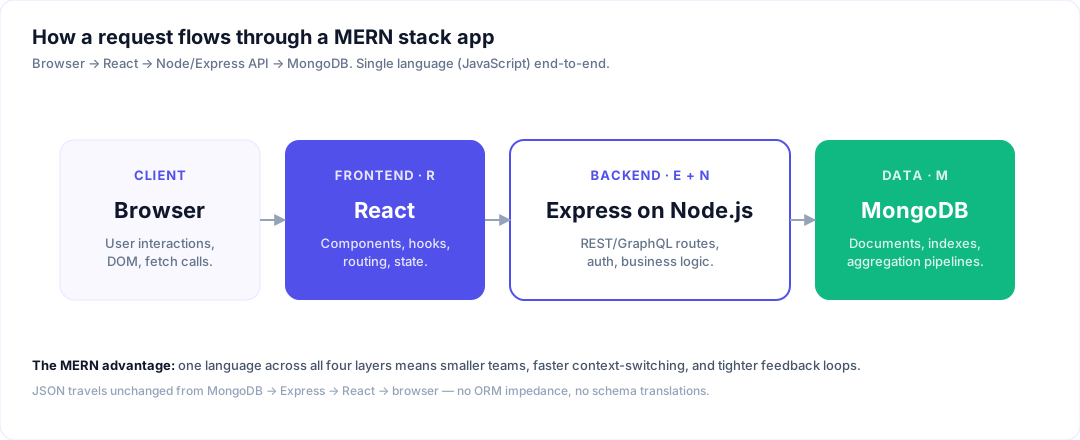
Practically, this means a junior MERN dev can ship a working feature without context-switching between languages or runtimes. That's the productivity unlock hiring managers are buying when they staff a MERN team.
MERN vs MEAN vs PERN vs Next.js — picking the right JS stack
Three other JS-first stacks compete with MERN. The choice usually comes down to two questions: do you want React or Angular on the frontend, and do you need a relational database?
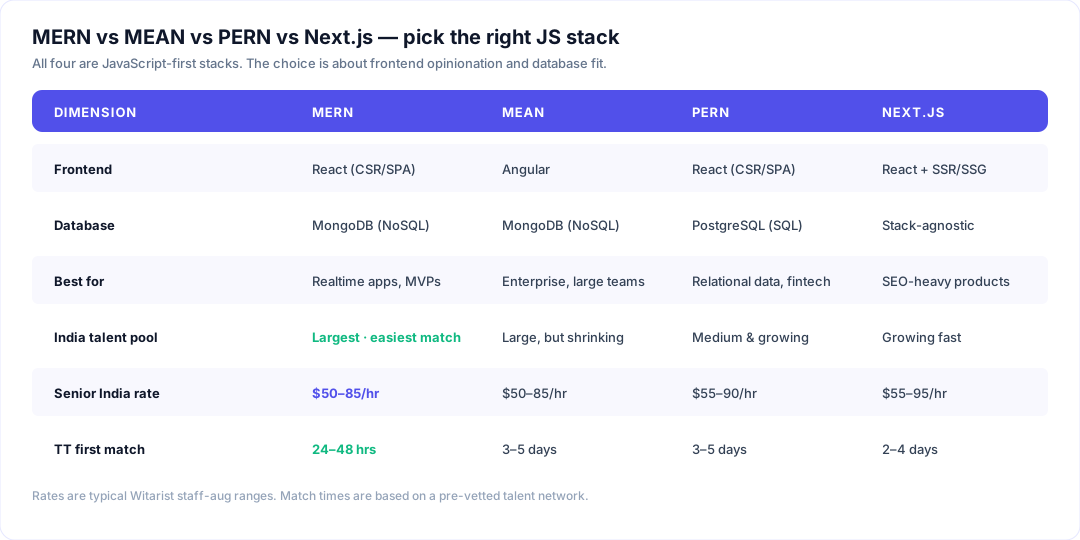
Quick decision rule: MERN for most product startups, MEAN if your team is enterprise/Java background, PERN if your data is genuinely relational (fintech, analytics, marketplaces with strict transactions), Next.js if SEO is a primary growth lever.
MERN skills checklist by seniority
When you're writing a role spec or screening profiles, here's what to expect at each level. Use this as a rubric, not a checklist — a good senior won't have ticked every box but will have shipped production work that proves the level.
Junior MERN developer (0–2 years)
- JavaScript / TypeScript fundamentals, ES6+ syntax, async/await.
- React basics: function components, hooks (useState, useEffect), props, simple routing.
- Express CRUD endpoints, basic middleware, environment-based config.
- MongoDB CRUD with Mongoose, simple queries, .find()/.findOne()/.update().
- Git fluency, REST basics, can read another engineer's code.
Mid-level MERN developer (2–5 years)
- TypeScript in production, generics, narrowing, decent type discipline.
- React patterns: custom hooks, code-splitting, Suspense, optimistic UI, form libraries.
- Express + auth: JWT/refresh tokens, OAuth, RBAC, rate limiting, CORS.
- MongoDB indexing strategy, aggregation pipelines, query plan reading.
- Testing across the stack, basic CI/CD, Docker for local dev.
- Comfortable owning a feature from spec → ship → on-call.
Senior MERN developer (5–8 years)
- System design: caching layers, queue workers, multi-tenant data isolation.
- Real-time at scale: Socket.IO clusters, Redis pub/sub, sticky sessions.
- MongoDB sharding, replica-set tuning, change streams, transaction patterns.
- Performance work: Lighthouse > 90, server-side rendering, edge caching, bundle analysis.
- Mentors juniors, runs code reviews with intent, writes ADRs.
Lead / Architect (8+ years)
- Owns the stack-wide tech roadmap, makes MERN-vs-microservices calls.
- Hiring panels, calibration, defining the engineering interview rubric.
- Cost reviews — knows what every API call costs at AWS/MongoDB Atlas scale.
- Security and compliance ownership: SOC2, GDPR, PII handling.
2026 cost to hire a MERN stack developer in India
Indian MERN talent is the densest pool in the world. That depth means low rates, fast match times, and the ability to staff junior, mid, and senior on the same project without paying a US scarcity premium. Here's the 2026 rate card we see most often:
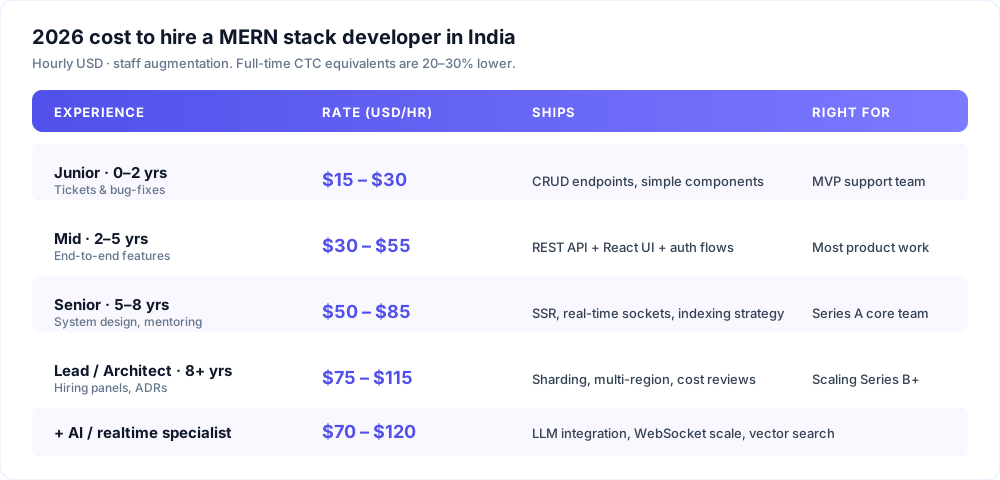
Compared to the US, you're paying 60–70% less for the same seniority. Compared to Eastern Europe (typical $55–95/hr senior), India still wins by 15–30% — and the absolute talent pool is multiples larger.
When MERN is the wrong choice
Honest answer: MERN isn't always the right call. Skip it when:
- Your data is fundamentally relational — multi-table joins, strict ACID, complex reporting. Use PERN (PostgreSQL) instead.
- You're shipping a content site where SEO is the growth channel. Use Next.js for SSR/SSG.
- Your existing team is Java/.NET shop. The retraining cost beats the productivity payoff.
- You're building heavy-compute (ML, video, simulation) — Python/Go/Rust win on the backend.
- You need fine-grained type safety and runtime guarantees. Consider TypeScript-first stacks like Remix + Prisma + Postgres.
How to hire a MERN stack developer in 48 hours
If the role is sprint-critical, here's the workflow most Witarist clients run from kickoff to onboarding:
- Day 0 — 30-min scoping call. Stack signals (any specifics: TypeScript strictness, GraphQL, real-time?), seniority, time-zone overlap, start date.
- Day 1 — three matched profiles. Pre-vetted CVs, code samples (real GitHub repos, not toy snippets), and 60-second Loom intros so you hear how they communicate.
- Day 2 — your interview. 60 minutes with your tech lead. We pre-warm the candidate on your stack so the conversation is signal-rich. Most clients shortlist 1 of 3.
- Day 2–3 — onboarded. NDA, contract, and access provisioning handled by us. Developer joins your standup. Pay only after onboarding.
Hire each part of the MERN stack — pre-vetted talent
If you'd rather staff each layer with a specialist instead of a single full-stack hire, our talent network covers each technology individually:
- Hire React.js developers — for the frontend layer of your MERN app.
- Hire Node.js developers — for the backend runtime, APIs, and real-time work.
- Hire Express.js developers — server framework specialists for high-throughput APIs.
- Hire MongoDB developers — schema design, indexing, sharding, and aggregation experts.
- Hire Full-Stack developers — one engineer who owns all four layers end-to-end.
- Hire Next.js developers — if you need React with SSR/SSG for SEO-heavy products.
- Hire Angular developers — for MEAN stack alternatives and enterprise frontends.
- Hire PostgreSQL developers — when you need PERN instead of MERN.
Need a stack we didn't list? Browse the full Witarist technologies catalogue — 50+ tech stacks with starting rates and live developer counts.
Why MERN dominates India hiring: Stack Overflow Developer Survey 2024 puts JavaScript and TypeScript as the #1 and #5 most-used languages globally, and React as the #1 web framework. India's 1M+ engineering graduates per year skew JS-heavy, which is why MERN matches faster than any other full-stack pairing.
The bottom line for CTOs hiring this quarter
A MERN stack developer is your highest-leverage hire when you need one engineer who can ship a feature end-to-end. The stack is mature, the talent pool in India is the deepest in the world, and the 24–48-hour match time on a pre-vetted network beats any in-house funnel by an order of magnitude.
Need a MERN developer in your standup this week? Tell us your stack signals and start date. We'll send three pre-vetted profiles within 24 hours — zero upfront cost, zero recruiter fees.
Related reading
More hiring guides: Cost to hire developers in India 2026, Hire React.js developers, Hire Node.js developers, or browse our technologies catalogue.