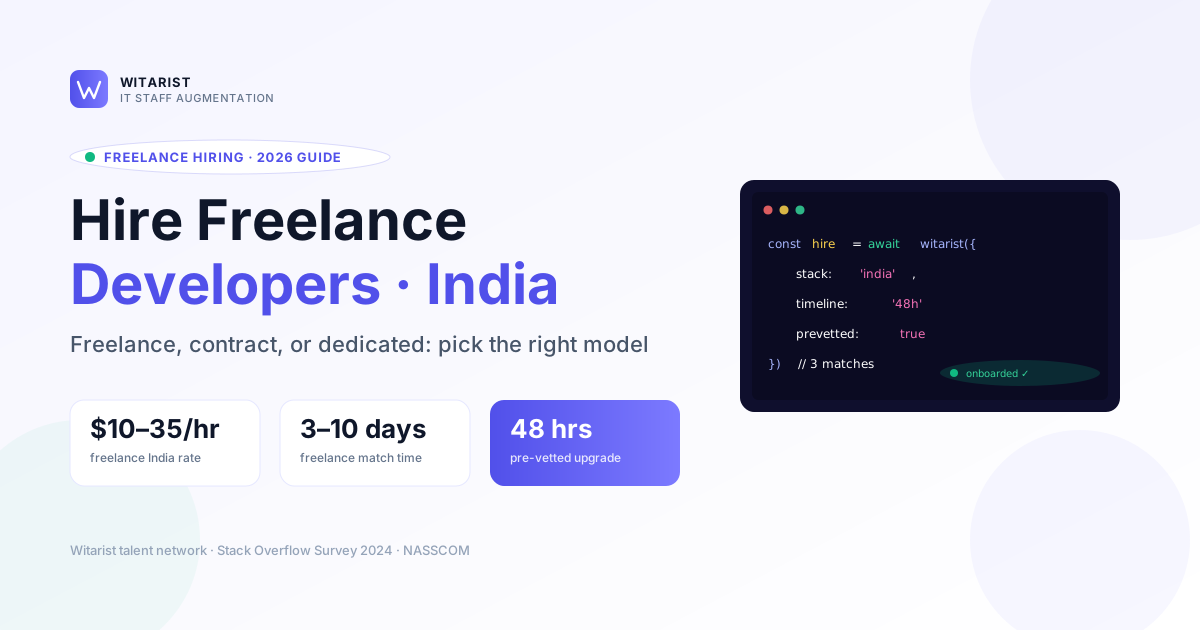
Ready to hire freelance software developers in India? Marketplace freelancers cost $10–$35/hour but carry quality variance and ghosting risk. Pre-vetted networks like Witarist run $25–$80/hour at senior level — with a 48-hour match, NDA, replacement guarantee, and a developer who actually finishes the engagement.
"Freelance" covers everything from a $10/hr Fiverr quick-fix to a $90/hr Toptal architect. The rate range hides what really matters: how the engagement is scoped, who's accountable, and what happens when something breaks. This guide unpacks the trade-offs for hiring managers serious about output — not just the cheapest hourly number on a profile page. By the end, you'll know which model fits a two-day patch versus a six-month build, and where the line sits between "good enough freelancer" and "needs a dedicated developer instead."
Why India for freelance software development
India has the world's largest pool of freelance developers — NASSCOM puts the country's STEM graduate output at 1.5M+ a year, with deep English fluency and rates 60–70% below US equivalents. The advantage isn't just cost; it's depth across stacks. Need a senior Laravel dev who also knows Stripe? You can find one in 24 hours. The Stack Overflow Developer Survey has tracked this same shift for years: a growing share of the professional developer population now works remote-first out of India, across every major framework.
Freelance hiring models compared
Four common paths. Pick by engagement length and risk tolerance:
| Engagement | Rate (India) | Start time | Best for | Risk |
|---|---|---|---|---|
| Marketplace freelancer (Upwork/Fiverr) | $10 – $35/hr | 3–10 days | Short fixes < 2 weeks | Quality variance, ghosting |
| Pre-vetted freelancer (Toptal/Witarist) Recommended | $25 – $80/hr | 48 hours | Sprint help, specialist gaps | Slightly higher rate |
| Dedicated developer (full-time contract) | $25 – $80/hr | 48 hours | 3+ month engagements | Time-zone management |
| Direct freelance (your own network) | $15 – $60/hr | 1–3 days | Repeat collaborators | No replacement safety net |
Pricing models: which one to use
Beyond the hourly rate, the pricing structure shapes incentives:
| Pricing model | When it works | When it backfires |
|---|---|---|
| Hourly | Scope is fluid; you want pay-as-you-go | Freelancer drags out hours; no incentive to ship fast |
| Fixed-price (per project) | Spec is locked, deliverables are crisp | Scope creep → "out of contract" haggling |
| Milestone-based | Clear deliverable stages, partial payments | Milestone definitions slip — write them tightly |
| Retainer (monthly) | Ongoing support, predictable burn | Used hours always fill the retainer ("Parkinson's law") |
Whichever model you pick, benchmark against real data before you agree to a number: PayScale's freelance developer rate data for India clusters in the same $15–$40/hr band most marketplaces quote — a useful benchmark if a freelancer opens 2–3x above that.
Red flags when hiring freelance developers
| Red flag | What to ask |
|---|---|
| 5-star rating but only 3 projects | "Walk me through your largest past project." |
| Generic CV with no GitHub | "Send me a recent PR you're proud of." |
| Promises sub-market rate | "What corners are you cutting to hit this price?" |
| Won't take a paid test | Walk away |
| Vague time-zone availability | "What 4-hour live overlap can you commit to?" |
| Always available, never busy | Likely juggling 5 clients silently |
A 5-step vetting checklist before you pay a freelance developer
Red flags tell you who to avoid. This checklist tells you what to actually do before money changes hands. Run it in order — each step is cheap, and skipping one is where most bad freelance hires go wrong.
| Step | What you do | Why it matters |
|---|---|---|
| 1. Portfolio + live code review | Ask for a GitHub link or a recent PR, not just a resume | Screenshots lie; commit history doesn't |
| 2. Paid 2-hour test task | Pay for a small, real ticket from your backlog | Filters out anyone unwilling to prove skill before invoicing |
| 3. Async communication check | Send a spec with an intentional ambiguity | Good freelancers ask a clarifying question; weak ones guess and ship wrong |
| 4. Reference call | Call one past client, not just read the review | Reviews can be gamed; a 10-minute call rarely is |
| 5. Milestone-based first contract | Structure payment 1: kickoff, payment 2: first working demo | Caps your downside if the engagement doesn't work out |
None of these steps take more than a day to run, and together they cost maybe 6–8 hours of your time across a week — cheap insurance against a $2,000+ engagement that goes sideways.
Freelance now, staff augmentation later: how to time the switch
Most teams start with a freelancer because the ask feels small: fix this bug, ship this feature, patch this integration. The problem shows up a few months in, when "one small ask" has turned into a roadmap with three overlapping freelancers, none of whom talk to each other or know your codebase beyond their own slice of it.
Three signals it's time to move from freelance to staff augmentation: you're renewing the same freelancer's contract for the third straight month, you're hiring a second freelancer just to review the first one's code, or the work has shifted from "a task" to "a role" — something that needs to show up in your standup, follow your sprint process, and own a piece of the product long-term.
A dedicated developer through staff augmentation costs 20–40% more per hour than a marketplace freelancer, but you get someone who works your hours, sits in your Slack, and is accountable to your roadmap — not juggling four other clients. If that trade-off sounds right, see how Witarist's dedicated developer model compares on rate, ramp time, and replacement terms.
The pre-vetted alternative
Marketplaces optimise for liquidity (more developers = better search results). Pre-vetted networks optimise for outcomes. Every developer in the Witarist pool clears a 4-stage screen (code, communication, references, async-fit) before profiles reach you. Roughly 1 in 28 applicants makes it through.
The trade-off is honest: you pay 30–50% more than marketplace rates — but match time drops from 7 days to 48 hours, quality variance disappears, NDAs are enforced, and replacement is free in weeks 1–2. For a one-off landing page, that premium is overkill. For anything touching production data, payments, or a paying customer's first impression, it's the cheaper option once you price in the cost of a bad hire.
Hire by stack
Browse pre-vetted India-based freelancers by tech: React.js, Node.js, Python, Laravel / PHP, WordPress, Full-Stack, or browse the technologies catalogue.
The bottom line
Freelance India is fine for prototypes and patches. For anything you intend to put in front of paying customers, upgrade to a pre-vetted network. The hourly delta is rounding error compared to the cost of shipping broken code into production.
Need a freelance developer with a 48-hour SLA? Tell us your stack and timeline. Three pre-vetted profiles within 24 hours — no upfront cost.
Related reading
More guides: Cost to hire developers in India 2026, Hire dedicated developers, Hire top-rated Indian developers, Hire programmers in India, or Hire dedicated Indian coders.