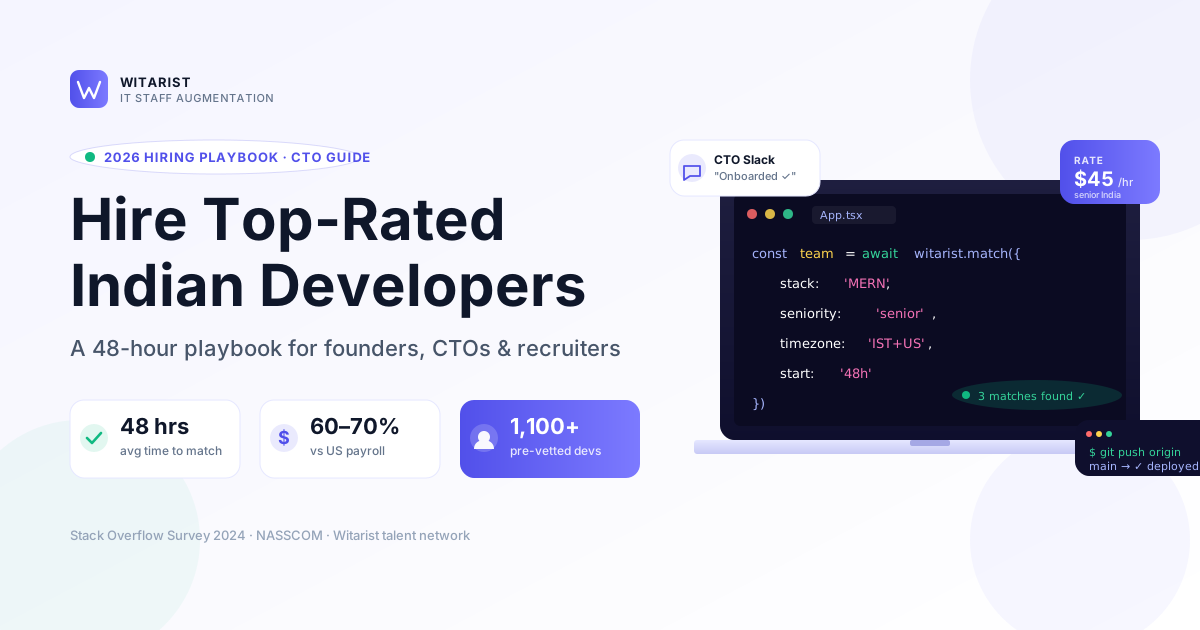
TL;DR for hiring managers: hire Indian developers in 2026 and you tap the densest pre-vetted developer pool on the planet — 1M+ engineers graduating a year, senior rates of $45–$80/hour, and 24–48-hour match times through staff augmentation. The rest of this guide is the rate cards, the time-zone math, the hiring-model trade-offs, and a 48-hour playbook to put an India developer in your standup this week.
If you're a founder racing toward a launch, a CTO scaling a backlog, or a recruiter filling a sprint-critical seat, you've already heard the pitch on India. This guide skips the marketing and gives you the operating numbers you need: 2026 rate cards by experience and stack, hiring-model trade-offs, time-zone reality, and what "top-rated" actually means after the screening round.
Witarist runs a vetted talent network of 1,100+ Indian developers across 50+ tech stacks. The numbers below come from our own placements plus public benchmarks (Stack Overflow Developer Survey 2024, NASSCOM, Glassdoor, PayScale).
Why hiring managers pick India in 2026
Four hard advantages, in the order they matter for a hiring decision:
- Talent pool depth: India produces ~1.5M engineering graduates a year (NASSCOM). The senior bench is the deepest of any single country outside the US.
- Cost arbitrage: 60–70% lower hourly rates than equivalent US seniority. The savings widen at lead/architect level, not at junior.
- English fluency: English is an official language of business and tertiary education. Async writing standards in major hubs match Western norms.
- Time-zone math that works: IST overlaps with US East Coast mornings, all of UK/Europe, all of SE Asia, and US West Coast evenings. With async tooling, every major business hub has 4+ hours of live overlap.
The real story: India isn't "cheap labour" — it's a deep talent pool with a favourable cost curve. The CTOs who win here treat Indian developers as full team members, not contractors-at-arms-length.
2026 hourly rate card: India vs US
Hourly rates for staff augmentation across experience tiers. Full-time CTC equivalents are 20–30% lower than these contract rates.
| Experience | India (USD/hr) | US (USD/hr) | You save | Best for |
|---|---|---|---|---|
| Junior · 0–2 yrs | $15 – $25 | $50 – $80 | ~70% | Bug-fix queues, MVP support |
| Mid · 2–5 yrs | $25 – $45 | $80 – $120 | ~65% | Feature ownership, on-call |
| Senior · 5–8 yrs | $45 – $80 | $120 – $180 | ~60% | Architecture, mentoring |
| Lead / Architect · 8+ yrs | $70 – $115 | $180 – $260 | ~58% | System design, hiring panels |
| AI · ML · Blockchain | $60 – $120 | $160 – $300 | ~55% | Niche tech, scarce talent pool |
Two patterns to notice. First, the absolute dollar gap widens at senior level — a US senior costs $120–180/hour while an Indian senior costs $45–80/hour. Second, the savings ratio compresses for niche tech (AI, ML, blockchain) because global demand for those specialists has bid up Indian rates faster than mainstream stacks.
Senior rates by tech stack
Pricing varies more by stack than by city. Here's what a senior Indian developer costs across our most-requested stacks, with expected match times through a pre-vetted network:
| Tech stack | India senior rate | Match time | Where it wins |
|---|---|---|---|
| React.js / Next.js | $45 – $75/hr | 24 hrs | SaaS dashboards, marketing sites |
| Node.js / Express | $45 – $75/hr | 24 hrs | JS-first APIs, real-time apps |
| Python / Django / FastAPI | $50 – $80/hr | 24–48 hrs | Data, ML, scientific APIs |
| Java / Spring Boot | $50 – $85/hr | 24–48 hrs | Enterprise, fintech, high-throughput |
| Full-stack (MERN/MEAN) | $50 – $90/hr | 24 hrs | Sub-15-eng startups |
| DevOps / SRE / Kubernetes | $60 – $100/hr | 48–72 hrs | Cloud migrations, reliability |
| AWS / GCP architects | $65 – $110/hr | 48 hrs | Multi-region, cost reviews |
| React Native / Flutter | $45 – $80/hr | 24–48 hrs | Cross-platform mobile |
| AI / ML / LLM specialists | $70 – $120/hr | 3–5 days | RAG, fine-tuning, agents |
If you'd rather staff specialists than full-stack generalists, browse the dedicated landing pages: React.js, Node.js, Python, Java, Full-Stack, DevOps, AWS, or React Native.
Hiring model showdown: which path fits your situation?
Four viable paths to put an Indian developer on your team. They differ on speed, cost shape, control, and risk:
| Model | Time to first dev | India rate | Best for | Watch-outs |
|---|---|---|---|---|
| Freelancer marketplace | 3–10 days | $10 – $35/hr | Sub-2-week tasks, prototypes | Quality variance, ghosting risk |
| Staff augmentation Recommended | 48 hours · pre-vetted | $25 – $80/hr | 3–18 month engagements | Plan ≥ 4 hr time-zone overlap |
| Direct in-house hire | 60–90 days | 1.4× CTC fully-loaded | Permanent strategic roles | Bad-hire cost ≈ 30% of salary |
| Outsourced agency | 2–4 weeks | $40 – $90/hr (markup) | Fixed-scope projects | Less control, opaque vetting |
For most Series A–C startups and mid-market scale-ups, staff augmentation has the best risk-adjusted ROI: 48-hour match, no recruiter fees, replacement guarantee, and contract flexibility. In-house wins only when the role is permanent strategic IP.
Time-zone math: how much overlap you actually get
The biggest question CTOs ask before going India-first: "Can the team actually work together?" Here's the live-overlap window with Indian Standard Time (IST = UTC+5:30) by region:
| Your team | Comfortable IST overlap | Hours/day | Working pattern |
|---|---|---|---|
| US East Coast (EST) | 9:30 AM – 1:30 PM IST | ~4 hrs | Morning standup overlap |
| US West Coast (PST) | 7:30 PM – 11:30 PM IST | ~4 hrs | Indian dev shifts evening |
| UK / Western Europe | 1:30 PM – 9:30 PM IST | ~6–8 hrs | Best overlap, near-aligned day |
| Singapore / SE Asia | Most of the working day | ~7 hrs | Effectively co-located |
| Australia (AEST) | 5:00 AM – 12:30 PM IST | ~3 hrs | India morning, AU afternoon |
The takeaway: UK/Europe teams get a near-aligned day, Singapore is effectively co-located, and US East Coast gets a comfortable 4-hour morning standup overlap. US West Coast is the trickiest — but with senior Indian devs willing to shift 4 hours later, it's solvable.
Where the talent actually lives — Tier-1 vs Tier-2 cities
Indian developer talent clusters in six Tier-1 hubs: Bangalore, Hyderabad, Pune, Delhi/NCR, Mumbai, and Chennai. Tier-1 cities have the densest senior bench but a 15–30% rate premium over Tier-2 cities (Jaipur, Indore, Coimbatore, Kochi, Ahmedabad). With remote-first delivery, the premium is often unnecessary unless you specifically need senior product engineers.
What "top-rated" actually means at Witarist
"Top-rated" without a vetting framework is marketing copy. Here's the four-stage screen every developer in the Witarist pool clears before their profile reaches you:
- Code & system-design assessment — live coding round, take-home with rubric scoring, and an architecture whiteboard appropriate to seniority level.
- Communication screen — English fluency check, async writing samples (an ADR or post-mortem they've authored), and a 30-min scenario interview.
- Reference and background checks — last two employers verified, education credentials confirmed, criminal record check where legally permissible.
- Cultural / async-fit panel — how they handle ambiguous specs, push back on a bad PR, and write up trade-offs. This is what predicts long-term engagement.
Roughly 1 in 28 applicants makes it through the four stages. That's the bar — and it's why the average time-to-first-match is under 48 hours: when a brief lands, we're matching from a pool that's already been screened, not from a cold pipeline.
The 4-day Witarist hiring playbook
If the role is sprint-critical, here's the workflow most clients run:
- Day 0 — 30-min scoping call. Stack signals, seniority level, time-zone overlap, budget envelope, start date. We translate that into a one-page brief.
- Day 1 — three matched profiles. Pre-vetted CVs, real GitHub samples (not toy snippets), and 60-second Loom intros so you hear how they communicate before you spend an interview slot.
- Day 2 — your interview. 60 minutes with your tech lead. We pre-warm the candidate on your stack and codebase context so the conversation is signal-rich. Most clients shortlist 1 of 3.
- Day 3 — onboarded. NDA, contract, GitHub access, and Slack invite handled by us. Developer joins your standup. You pay only after onboarding completes.
5 mistakes hiring managers make with Indian developers
- Hiring solely on hourly rate. A $20/hr freelancer who needs 3× the hours of a $50/hr senior costs more, ships slower, and risks IP leakage. Compare output per dollar, not rate.
- Skipping the 30-min comm screen. Technical talent without async writing skill turns every status update into a 20-message Slack thread. Always interview the writing.
- Treating contractors as second-class. Indian developers who feel embedded in your roadmap retain longer and ship better. Invite them to planning calls. Share the why.
- Ignoring time-zone discipline. Pick a 4-hour live overlap window and protect it for standups, code reviews, and live debugging. Async-everything sounds great until production breaks at 3 AM.
- Skipping the trial period. Even with pre-vetting, run a 2-week paid trial on a real ticket before locking in long-term. The best networks bake this in (Witarist does — replacement is free in week 1–2).
Developers in India vs developers from India — does the label matter?
Two phrasings, one talent pool. "Developers in India" usually means engineers working from a hub like Bangalore or Hyderabad on IST. "Developers from India" often means Indian engineers working remotely for a US or EU company. For a staff-augmentation engagement the distinction rarely changes the outcome: you get the same pre-vetted India developers, the same 160 guaranteed hours a month, and the same NDA and IP transfer signed on day one. What actually moves the needle is seniority, stack fit, and a protected overlap window — not the city printed on the contract. Most CTOs we talk to stop worrying about "in" versus "from" once they see the first three matched profiles.
The bottom line for hiring managers
Hiring top-rated Indian developers in 2026 isn't an offshoring play — it's a velocity play. 48 hours from brief to onboarded developer, 60–70% lower payroll, no recruiter fees, full IP protection, and replacement on demand. The CTOs who win this decade treat staff augmentation as a default — not a last resort when in-house hiring slips.
Need a top-rated Indian developer in your standup this week? Tell us your stack, seniority, and start date. We'll send three pre-vetted profiles within 24 hours — zero upfront cost, zero recruiter fees, replacement guaranteed.
Related reading
Continue with the deep-dives: Cost to hire developers in India 2026, What is a MERN stack developer?, or browse our technologies catalogue to find your stack.
Hiring for a specific stack or role? Our companion guides on how to hire programmers in India and hire dedicated Indian coders carry role-specific rate cards and vetting checklists that pair with this India developers overview.