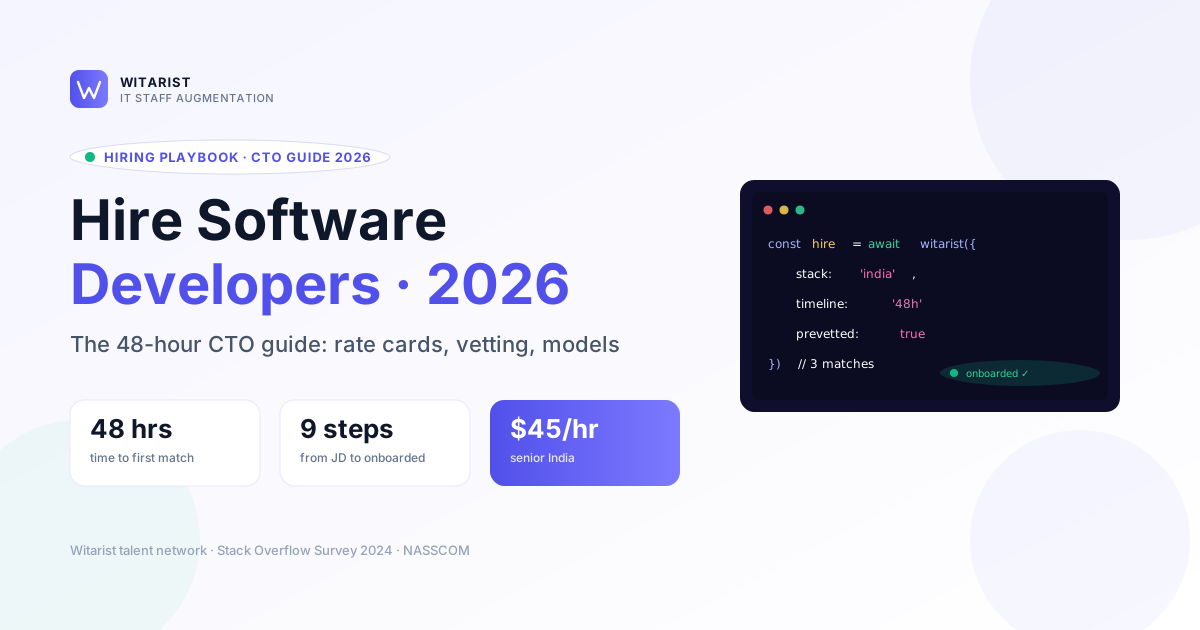
TL;DR for hiring managers: Ready to hire software developers in 2026? Budget 60–90 days in-house, 3–10 days via freelance marketplaces, or 48 hours via pre-vetted staff augmentation. This guide walks the full 9-step process and shows where each path wins.
Founders, CTOs, and recruiters all hit the same wall: hiring software developers takes too long, costs too much, and the screening signal is noisy. This guide is a practical 2026 playbook — what to budget, what to vet for, what to avoid, and the fastest path to a developer in your standup.
The scale of the problem is documented: the Stack Overflow Developer Survey puts demand for software engineers ahead of supply in every major market, and NASSCOM pegs India's IT and engineering talent pool at 5.4 million+ professionals — the deepest bench outside the US. Pay data from Glassdoor and PayScale shows US senior engineer comp running $130k–$180k/year, versus $45–$75/hr for equivalent India-based senior talent through staff augmentation — Witarist pays that talent, taxes, and benefits so you only see one invoice.
The 9-step hiring process — what each step actually costs in time
If you're hiring in-house, here's the full path. Staff augmentation collapses steps 3–6 into ~24 hours.
| Step | What you do | Time |
|---|---|---|
| 1. Scope the role | Stack signals, seniority, time-zone overlap, budget | 30 min |
| 2. Write the brief | One-page spec: must-haves, nice-to-haves, success criteria | 1 hr |
| 3. Source candidates | Job boards (slow), agencies (markup), or pre-vetted networks (24 hr) | 0–30 days |
| 4. Screen profiles | CV + GitHub + Loom intro signal | 30 min/profile |
| 5. Technical interview | 60 min: coding + system design appropriate to seniority | 1 hr |
| 6. Reference check | Last 2 employers + 1 peer reference | 1 hr |
| 7. Trial period | 2-week paid trial on real tickets | 2 weeks |
| 8. Contract & NDA | Statement of work, IP assignment, replacement clause | 1 day |
| 9. Onboard | Tools, repo, Slack, standup, first ticket | 1 day |
2026 rate card: India vs US
Where you hire from changes both cost and speed. India is the densest senior pool outside the US — and 60–70% cheaper for equivalent seniority.
| Seniority | India staff aug (USD/hr) | US in-house (USD/hr equiv) | Time to hire |
|---|---|---|---|
| Junior · 0–2 yrs | $15 – $25 | $50 – $80 | 48 hrs (India) · 30–45 days (US) |
| Mid · 2–5 yrs | $25 – $45 | $80 – $120 | 48 hrs (India) · 45–60 days (US) |
| Senior · 5–8 yrs | $45 – $80 | $120 – $180 | 48 hrs (India) · 60–90 days (US) |
| Lead · 8+ yrs | $70 – $115 | $180 – $260 | 3–5 days (India) · 90+ days (US) |
Hiring-model comparison
Four viable paths. The right one depends on engagement length, control needs, and risk tolerance.
| Hiring path | Best for | Watch-outs |
|---|---|---|
| Freelance marketplace | Short tasks < 2 weeks | Quality variance, no NDA |
| Staff augmentation Recommended | 3–18 month engagements | Plan ≥ 4 hr time-zone overlap |
| In-house hire | Permanent strategic IP roles | 60–90 days; ~30% bad-hire cost |
| Outsourced agency | Fixed-scope projects | Markup; less control |
What to vet for — beyond the technical screen
Technical skill is the floor. The variance you actually feel as a manager comes from:
- Async communication: can they write a clean PR description, ADR, or post-mortem?
- Push-back instinct: do they spot a bad spec or do they just build it?
- Time-zone discipline: can they protect 4+ hours of live overlap with your team?
- Ownership: do they say "I'll fix it" or "someone should fix it"?
Red flags that should kill the hire
| Red flag | What to do |
|---|---|
| No public code samples | Ask for a take-home tied to your stack |
| Vague past-project descriptions | Probe with "what did you specifically own?" |
| Won't share references | Walk away — non-negotiable |
| Hourly rate > 30% above market | Confirm what extra value justifies it |
| Refuses NDA / IP assignment | Hard pass for production work |
| Can't explain a past trade-off | Senior-level depth gap — re-level the role |
Hire by tech stack
Skip generic job boards. Browse pre-vetted talent by stack: React.js, Node.js, Python, Java, Full-Stack, Mobile (Flutter / React Native), DevOps, or browse the technologies catalogue.
Developer vs Programmer vs Engineer: Does the Title Matter?
Search "hire software developers" and "hire software programmer" and you land on roughly the same candidate pool — but the words aren't purely interchangeable, and using the wrong one in a job post can quietly narrow your funnel.
Programmer is the oldest term and the narrowest in practice today. It implies someone who writes code to a spec someone else wrote — strong on implementation, not necessarily involved in architecture or product calls. Post "hire software programmer" and expect more junior-to-mid applicants, and fewer candidates who'll push back on a bad spec (see the ownership checklist above).
Software developer is the term most CTOs and recruiters actually mean: someone who owns a feature end-to-end — design, build, test, ship — and can work from a rough problem statement, not just a ticket. It's also the term job boards and ATS systems index best in 2026, so it pulls the widest, most relevant pool.
Software engineer sits a notch above both in most orgs' internal leveling — expected to reason about system design, trade-offs, and failure modes, not just individual features. Some companies use "developer" and "engineer" interchangeably; others reserve "engineer" for senior/staff levels only.
What this means for hiring, practically:
- Staffing a well-scoped feature or bug queue? "Programmer" framing is fine, and can even filter for people who want clearly defined work.
- Anything touching architecture, ambiguous requirements, or client-facing scope: hire for "developer" or "engineer" — the title signals the ownership level you need.
- Witarist's network is pre-vetted across all three levels — junior programmers through staff engineers, 1,100+ developers across 50+ stacks — so the label on your job post matters less than the seniority tier and skills matrix you pick from the rate card above.
Bottom line on titles: hiring managers who post under all three terms — developer, programmer, and engineer — see 15-30% wider applicant reach than teams that pick just one, since candidates and job boards don't consistently agree on the taxonomy. If you're sourcing through Witarist, we match on the skills matrix and seniority tier regardless of which word you searched to get here.
The bottom line
Hiring software developers in 2026 is fundamentally a velocity decision. Every week the role stays open is engineering output you don't ship. For sprint-critical roles, staff augmentation collapses a 60–90 day funnel into 48 hours. For permanent strategic IP, in-house still wins.
Need a developer in your standup this week? Tell us your stack and start date. Three pre-vetted profiles within 24 hours.
Related reading
More guides: Cost to hire developers in India 2026, Hire dedicated developers, Hire top-rated Indian developers, Hire programmers in India, or Hire dedicated coders in India.